
Joint hypermobility and related disorders :
studies in emotion, cognition and behavior.
Home | Team | Studies | News | Publications | Support us | Partners

DOSEDv Study: Chronic pain in vascular Ehlers-Danlos syndrome: determinants, functional impact, and patient coping strategies.
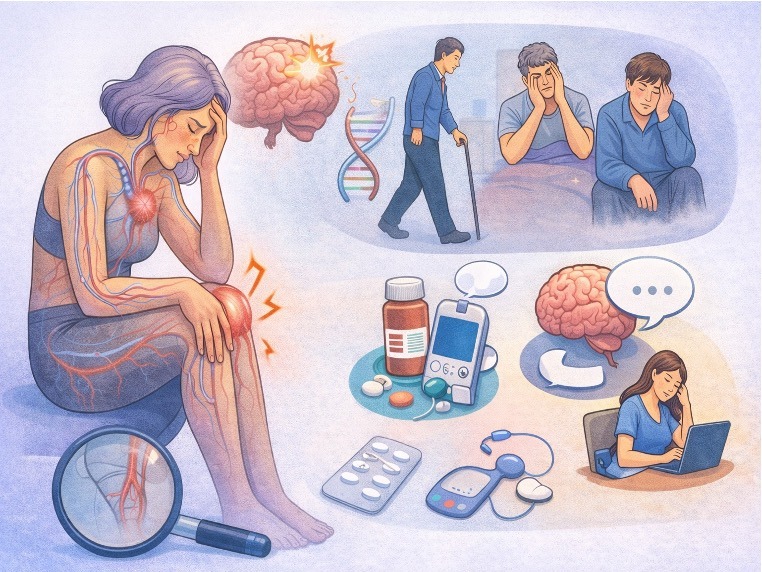
Background: Among the 14 subtypes of Ehlers-Danlos syndromes (EDS) described to date, one of the most severe is the vascular subtype (vEDS, formerly known as type IV). vEDS is caused by mutations in the gene encoding type III collagen alpha-1 (COL3A1), leading to exceptional fragility of arteries and organs, as well as an increased risk of premature death. Indeed, patients with vEDS are exposed to life-threatening complications such as aneurysms, dissections of the aorta and other arteries, and organ ruptures.
Beyond these serious complications, chronic pain—still poorly studied in this subtype—affects a significant number of patients. However, vEDS remains under-described and only marginally recognized in the scientific literature as a syndrome associated with chronic pain, unlike other forms of EDS, such as hypermobile or classical EDS. Consequently, the lack of knowledge regarding pain in vEDS may result in care that is sometimes incomplete or non-specific, potentially increasing patient vulnerability.
In this mixed-methods study, we aim to explore:
-
The frequency and characteristics of chronic pain in patients with vEDS, as well as the associated functional impact;
-
Sociodemographic, physical, and psychosocial factors associated with chronic pain in this population;
-
The subjective experience of patients with vEDS suffering from chronic pain, and the strategies they employ to cope with it.
Researchers: C. Baeza-Velasco, T. Mirault, X. Jeunemaitre, M. Frank, A Bensaou.
Affiliated Institutions: LPPS Laboratory – Université Paris Cité; Rare Diseases Reference Center, Hôpital Européen Georges-Pompidou, AP-HP; VEDS France Patient Association.
Funding: Fondation Maladies Rares.